Boil a vet's job down into it's very basic components and you're left with three parts; the elementary particles of veterinary life, if you like (incidentally, please don't boil a vet down into their basic components; you'll just end up with a nasty-smelling soup and an unhappy vet). These three fundamentals of the job are 'consults', 'ops' and 'visits'. I've talked about consulting and operating a few times before (here and here, for instance) but it's the last of the three that I'm going to talk about today. The dreaded visits.
(While I think about it, you could argue that there is a mysterious fourth particle, the OOH particle, representing out of hours (emergency) work - but I would suggest that instead all OOH is merely a dark mirror of the basic work; the veterinary equivalent of anti-matter - for every consult, there is an OOH consult. I'm getting a bit carried away with metaphor, aren't I? Must be the coffee).
So, visits are the part of the job where you leave the practice and visit your patient at their home. So...dreaded? Why dreaded? Why when a visit pops up on the board does that procedure you've been trying to avoid all day suddenly look a lot more attractive? (A visit? Oh, I'd love to, but, erm... well, I've got that constipated cat that I really need to clean out. Shame.)
Well, as with anything in life, there's pros and cons to visits. Let's do the cons first - I'm that type of person, you see.
(And I should point out at this stage that this blog is written from the perspective of a small animal vet; it can't help but be, because that's what I am. I'll just mention here that for a large animal vet (or the increasingly endangered 'mixed' vet) much of this doesn't apply, as their whole job consists of travelling from visit to visit, with brief trips back to the practice to scrape the worst of the cow shit off. Their visits are a little different though, as they are often to people that they already know and have visited many times before, and are often combined with some kind of surgical procedure (usually on the patient) and
First up - finding the place. People live in the craziest places - on top of hills, beside rivers, squeezed into the tiniest possible gaps on housing estates. Couple this with many people's complete inability to give directions to their own home, and you have a problem before you've even pressed the doorbell (I don't exclude myself from this group - never ask me directions to my house. I seem to notice landmarks that mean nothing to normal people. 'Go left after the tree that looks a bit like a pirate, and you'll come to a scary wood that would be a great setting for a ghost story...')
This isn't so bad if you're just heading out to clip a puppy's claws, but I have uncovered a hitherto unknown physical law, which states that the later the hour and the more urgent the call, the harder the clients house will be to find. Writing this, I can think of many stressful middle-of-the-night calls attempting to drive with an A-Z on my lap, swearing at the car, the map, my legs and life in general. Of course, now everybody has SatNavs, so complaining about this makes me sound as bad as someone moaning that there has been no good music made since 1994 (but seriously, have you heard what they're listening to nowadays?), but SatNavs are neither infallible nor particularly good at calming you down when you're stressed, so the problem still periodically raises it's head.
Secondly, people. I suspect that it won't be news to my readers if I suggest that people, although many of them can be caring, compassionate, big-hearted, generous, grateful and charitable, are, more often than not, just plain weird; and if they're weird when they're in the bank or doing their shopping, then that weirdness is likely to dramatically increase when they are safely back in their houses, away from the judging eyes of the rest of humanity (and if, incidentally, you don't understand what I'm getting at, then I'm afraid there's a fair chance that you're one of the people I'm talking about).
Partly this is a problem because you're out of your comfort zone on a visit, away from your safe consulting room where you know where the thermometer and hand wash is, and in a place where you don't know what the sticky patch on the floor is, or what that peculiar smell is, or just who that person is at the back who isn't saying anything, but just staring it you wearing only a towel. If I say that the village closest to my first practice had 'twinned with Royston Vasey' scrawled across it's welcoming road sign in black spray paint, you may understand why I've become slightly nervous of visits.
As well a people who are a little...well, different, there's people who are just plain unpleasant. I've been personally threatened with violence a couple of times on visits. Both times I had been called out to put an animal to sleep, and arrived to discover that some members of the family disagreed with that decision. Sadly, in both cases it was the members of the family with the largest fists and the shortest tempers.
That last point touches upon another problem with visits; what you're actually going out there to do. In most situations, people will bring their animals in to the practice, and visits usually only happen when people are housebound with no way of getting in to see us, or if the pet is of such a personality that it gets in far too much of a panic when it gets brought in - this often means that the animals we're off out to see are more skittish and possibly more aggressive than those we normally see in the practice, and we're going to see them with less manpower (usually just one vet, or one vet and a nurse), and we're invading their home territory to boot. Not really a recipe for fun.
The other situation you'll visit an animal at home, of course, is when it is the last visit they will ever receive. Some people choose to have their animals put to sleep at home, in familiar surroundings, so that they don't go through the stress of being taken in to the practice. Who can argue with that? It's what I'll do for my animals, too - but it does mean that a high proportion of home visits are euthanasia visits. The lack of manpower can cause a few problems here, too. I well remember a time, a few years into my career, when I visited an elderly woman who lived in a large house in a seaside village to put her great dane to sleep. It was a Sunday afternoon, and that meant that it was just me, no nurses. The procedure went smoothly (the poor dog was very, very ill) but then we were faced with something of a problem - although I am, of course, incredibly manly and strong, I couldn't lift an eighty kilogram dog by myself. The old woman was almost bent in two with back problems, but she didn't seem worried.
'Just a second,' she said, brightly. She opened the front door and hobbled out to a man who was passing by. 'Excuse me,' she said. 'Could we just have a hand lifting something?' The kind stranger agreed, and it was only when he walked into the living room that he realised exactly' what the 'something' was. Poor guy. He took it in his stride, though, only looking aghast for a few seconds before he helped me carry the dog. I often wonder what he told his family and friends about that day.
It was while I was working at the same practice when I received a call from a man asking me to visit him to put his canary to sleep. It was, of course, a Sunday afternoon again, and I was extremely busy, so I asked if there was any way he might be able to bring it in to the practice.
'I can't get near it,' he said, sounding nervous.
'Er...right. Is it somewhere you can't get to?' I asked, thinking it might have flown up into his loft or something.
'No, no, it's outside the front door, tied up, but he won't let me get past him. I can't even get to the car!'
The mental image of a massive bird, all wide-staring eyes and saliva-dripping from its beak viciously pecking anyone who dared to step near it confused me enough that it took me several minutes to understand that the man was actually talking about a presa canary - an enormous mastiff-type dog several rungs higher than the Hound of the Baskervilles on the 'violent bastard' ladder, and about as far from a gentle yellow bird as it is possible to get without watching a horror film. It turned out he'd bought it from his mate down the pub, and now it wouldn't let him leave the house. In the end we had to enlist the services of a vet with a blowgun, who darted it into unconsciousness so that the deed could be done.
I can also sadly remember the many times I have visited people to put their pets to sleep, and taken them back to the practice with me. There's something awful about taking someone's companion away with you, and leaving them alone in the house. I do always ask if someone is coming round to keep them company after I've gone, but the answer isn't always yes.
So, there's a lot of cons about home visits - but there's a few pros, too. It gets you out of the mania of the practice for a little while, and it's always nice to have a breather. Secondly, and principally, it gives you a chance to be nosey - the same kind of nosey as peeking into people's living rooms as you pass them by (I swear that's half the reason my wife rides horses; she gets a much better view from higher up, you see). I think this interest stems from the nagging feeling a lot of us have that we are the weird ones mentioned above; that there's something not quite normal about our own households, and other people do it differently. Well, we're right. After an extensive study of other households over the years, I can reassure you all that you're right; everyone is a bit strange, and weird is actually the normal state of affairs. It's the normal ones you've got to watch out for.
Well, that covers most things I wanted to say on the topic. In conclusion, I'd just like to add... sorry, just getting a message from the practice... what was that? A visit to do? Clip a canary's claws? Er... well, I'd love to, but I've got some impacted anal glands that really can't wait any longer...
Monday, 28 May 2012


Sunday, 13 May 2012
Fundtastic!
Hi all
This is a brief and rather humble post (I know, normal service will be resumed shortly!) to say thank you to everyone who has funded The Express Diaries - we've reached our target in under a week, so my new novel will definitely see the light of day!
There's still some exciting rewards available for funders - see over at www.indiegogo.com/expressdiaries - but I really just wanted to say thank you all. You're all lovely. Especially you - yes, you, there.
I've been rather busy of late with promotions (which I'm sure my twitter followers will be heartily sick of by now) and work, but I haven't forgotten about the blog - I'm hoping to do a little piece about home visits some time in the next week.
Until then - thank you! You're all, as I'm sure Stephen Fry would say if he were here, enormous buckets of loveliness.
As a reward, here's a rather excellent trailer that YSDC made for the book :
http://www.youtube.com/watch?feature=player_embedded&v=xU_ZUAlsT6E
Friday, 13 April 2012
All Aboard!
 |
| All aboard! All aboard the Orient Express! |
Yes, it's officially my least imaginative blog title ever (and it's up against some pretty stiff competition, believe me)
This is a quick post to mention that my new novel, The Express Diaries, has now been officially announced over at www.yog-sothoth.com.
The Express Diaries is a pulp horror adventure set aboard Europe's most famous train, as our intrepid heroes race across the continent to try and thwart a twisted cult from fulfilling their evil plans (mwah hah hah!)
I've done a few teasers about the novel already - you can read a few sample sections here and here. The book itself is going to be funded one of them-thar new fangled fundraiser things. This is good for us, because it ensures the book will be paid for before we publish it - and what's more it's great for you, because there are some pretty exciting rewards up for grabs if you want to help out - such as being written or drawn into the novel yourself, signed copies of the artwork and book, and much more!
The fundraiser has now started - pop over and have a look at the exciting offers available! So, I hope you'll join me as we go full steam ahead on our train ride into adventure and darkness. Let's hope it doesn't go off the rails...
(What a line, eh? Garth Marenghi would have been proud of that one!)
Monday, 9 April 2012
Mistakes
Regular readers of my blog will probably be aware by now that the tone of my posts tends to vary wildly between flippant and maudlin - sometimes even within the same post. I'm going to be honest; this isn't one of the flippant ones. Consider yourself warned.
'Experience is the name everyone gives to their mistakes' - Oscar Wilde
There's a nice little word that you can use in medical terminology - you may have heard it before. I may even have mentioned it in the blog before. That word is 'iatrogenic'. It's especially useful for those of us in the field because it sounds nice and official, slightly intimidating, and mysterious. Here's what it means - the doctor did it. Your physician ballsed up in some way, and now you're ill because of it. If you've got iatrogenic Cushing's disease, it's because the doc gave you too many steriods. If you've got iatrogenic aural trauma, then it's likely he was a little overenthusiastic with his otoscope. If you're iatrogenically monorchid...well, you get the idea.
There's a reason that this word was created, and that reason, of course, is that doctors (or in the case of this blog, vets) make mistakes. You may be getting an inkling of where you think this blog is going, now, but you may be wrong. I'm afraid this isn't going to be an 'Alright on the Night' style list of amusing veterinary cock-ups, where the poor James-Herriot-alike accidentally drills through their own finger whilst attempting to pin a fracture (though, I must admit, I have known that happen). No, this is really a confessional blog, a penance for me for a mistake I made. I did warn you at the start.
You see, I've been reading through my blog posts recently, and much as I like them, I do rather give the impression that I never make any mistakes myself, and that the hard positions I've found myself in have been due outside influences. This is, I will admit now, not the case. I have - in common with most of humanity, I suspect - made many mistakes, both in and out of my career. It's possible that this blog post is one of them. But I am so weary of politicians and others in the public eye avoiding even talking about, let alone admitting to, errors they have made on the basis that they may - horror of horrors - actually be called to account for them, that I wanted to make my own claim to honesty here.
I've been a vet for a long time now - ten years - and it has been quite some time since I felt that awful 'out of my depth' feeling that lived with me as a new graduate. Considering how much I've learned since then (and see Oscar Wilde's quote above for the true meaning of 'learning'), I'm a little surprised, when I think back on it, how few serious problems I got in to. Most of them were learning how to communicate with clients effectively and fairly, or easily corrected surgical mistakes, but here is something that has stayed with me down through the years :
I was a new graduate - maybe three or four months into the job, and it was one of those evening surgeries - the kind where all your old cases come back to haunt you. Nothing has got better, some things have got worse, and even the vaccinations have got heart murmurs, or sinister-feeling lumps that the owner has never noticed. I've had many, many of them since, and have discovered that really all you can do is take things one at a time, and remain calm. Back then, watching with alarm the list of people waiting grow whilst I was trying to think about a Chinese water dragon that had just been presented to me 'off-colour' (as I recall, it turned out to have been dead for a few days), panic was setting in. It was the first time I had experienced anything like it.
I was on my own - my colleague (a keen surgeon - a classic of the breed, very interested in the technicalities of the work. The animals, not so much) had left me to take one of his spinal cases to...well, I remember it as MRI, but I wonder now if, all those years ago, it would have been far more likely to be a C-T scan. Doesn't matter) and no cavalry was coming to save me. The 'complaints' list on the computer, a brief description of what was wrong with each animal, read like a thesaurus - 'worse','no better','no improvement'','poorly' etc - and I had just run out the back with my immobile water dragon to try and get a better look, when I got the phone call.
I forget the name of the breeder, and I wouldn't put it here even if I could remember, but she had phoned the practice to speak to my boss, and was upset that he wasn't around. She was even more upset to discover that the only vet she could talk to was the new graduate - and if she'd realised my state of mind at the time, she probably wouldn't have spoken to me at all. She had a reputation at the practice for being incredibly demanding - and any vets reading this will have a picture in their minds right away of exactly the sort of client I'm talking about. Flustered, with one eye on the water dragon (about which I was starting to suspect the truth - it's not quite as easy as you might think to immediately diagnose death in a reptile. Well...not if you've never seen one before. Anyway, that's not the mistake. I got that one right, in the end, it just took me a while) and another on the ever-growing waiting room list, I took the receiver from my nurse.
The situation explained to me was this : one of the breeder's bitches has just finished whelping. The births had gone fine, but one of the puppies had been born with a severe umbilical hernia - it's intestines had prolapsed through the large hole and the pup was not looking at all well. The breeder wanted me to go straight out to her and put the puppy to sleep.
This (like most things in those days) was not a situation I had been in before - I had never seen, or even heard of a puppy with such a severe problem. The breeder was adamant that the problem could not be fixed, and it certainly sounded serious enough to me. This is painful to write - but that's the whole point of this blog, isn't it? - but I agreed the puppy needed to be euthanased.
That's painful to write, because it's wrong. It's a treatable condition with immediate surgery, and I have fixed a number of puppies in a similar situations since. I was wrong, but that wasn't the worst of it.
I couldn't get out on a visit; I knew that. I had a waiting room full of people and no back-up. I asked her to bring the pup in, and she absolutely refused - she couldn't (she said) leave her bitch, and all the other puppies, just to bring this one in.
I wince to think of it. Older now, and wiser, I would have told her to bring the whole lot in right away. I also would have told her the pup could have been saved. I didn't. I merely feebly protested that I couldn't make it out.
'That's okay,' the breeder said. 'I'll deal with it myself.' She wasn't rude, or annoyed. She had really just wanted to check whether I thought the puppy should be put to sleep or not. She put the phone down. I didn't ring her straight back. Instead, I got on with my evening surgery.
Twenty minutes later my boss phoned me. He had a number of missed calls on his mobile phone from the breeder in question. When he got back to her, he found out what had happened. It was here that I discovered that the condition could have been surgically corrected. My boss had also discovered what had happened to the puppy.
She had drowned it.
I cannot tell you, dear reader, the number of times I have played that phone conversation over in my mind, wishing I had handled things differently. I can't count the number of nights I have lain in bed, staring at the ceiling and thinking of the pup, struggling against calloused hands, bubbles escaping from its mouth. That one mistake, based on a lack of veterinary knowledge and poor client handling, has haunted me for years. Its taken me ten years to write it down.
I don't even know, at this stage, how bad that seems to someone else. Its grown to be so large in my mind that I find it hard to think and write about, even now. I've made mistakes since then, of course - some worse that this one. But it was my first one, my first realisation of what can go wrong in just a few seconds of thoughtlessness. The drowning puppy lives in my mind (and only in my mind - it's painful to think that it could still be alive even now, all these days, weeks and years later, if I had acted differently) as a symbol of failure, and mistakes. Whenever things go wrong - which thankfully is not so often, these days - I think of that pup.
So, my confession is done. Don't think for a moment that this is my only error in ten years. As you may have suspected, this blog was prompted by a mistake as well, and of a similar kind. A few moments thoughtlessness, forgetting what really is at stake if I don't try my hardest, may have cost another animal its life. I ignored my instincts and took an easier path, and I was wrong. Likely it would have made no difference - in fact, I'm almost certain that in my recent error of judgement, acting different would have merely meant that the animal ended its struggle in the practice, rather than at home. Almost certain. But I'll never know now.
I suppose the hallmark of a mistake, as opposed to simple bad luck, is that if you think back over the situation - like I have, many times, thought over my phone call to the breeder - and you wish you had done something other than what you did, then you made a mistake. And that's how I feel today about this new mistake. I could have acted differently, and I wish that I had.
I'm not perfect. I wonder, if any vets are reading this, how many of them have their own version of the drowning pup, that swims into their mind when things go wrong? More than a few, I suspect. I'm so sorry that I failed then, and I'm saddened to realise that the lesson, hard and painful though it was, still needs reinforcing to me from time to time. This post is a way of doing that.
Thanks for reading.
Thursday, 22 March 2012
The 99p Challenge!
Ahh, - the 99p Challenge. A fondly remembered radio 4 show from back in the days when Simon Pegg wasn't immensely famous. And also, coincidentally - and for a limited time only - the new price of my fantasy eBook, the Ancients!
That's right - don't waste your money on a couple of Snickers bars (although they will forever be Marathon bars to me) or a litre of organic milk, when you can get a whole full length fantasy eBook instead. The Ancients is crunchy, nutritious, free of additives is ONLY ONE CALORIE! What more could you ask?
For the Kindle-types amongst you, The Ancients can be procured from your friendly local amazon store, amazon.co.uk. If you are lucky enough to live in the US (at least, for the purposes of this offer) then you can get the Ancients for the EVEN CHEAPER price of $0.99! (I've no idea what your chocolate bars cost over there though, but I can say from bitter experience of attempting to eat a Reece's Pieces bar that confectionary does not translate well across the Atlantic)
If you have a different eReader, or for some reason you like reading your eBooks in a different format every day, head over to smashwords, where your $0.99 will get you 8 different file types - including ePub, PDF and .doc, as well as being available for online reading.
So, don't delay! Join the 99p revolution - the challenge is simple! Merely click on the link, part with the teeny tiny amount of money, and enjoy your new eBook.
(Also, track down the 99p Challenge and listen to it - it's very good)
(PLEASE NOTE - YOU'VE MISSED IT NOW, SORRY. It's back up to £1.99 - but don't let that stop you!)
Monday, 19 March 2012
The Express Diaries - 2
And so, it's time to tease you a little more with a few glimpses into my new novel. They say a picture paints a thousand words - so here's a whole short-story's worth from Eric's easel...
 |
| Ms. Grace Murphy - young spinster, secretary to Betty Sunderland, and good friends with Violet Davenport ***** |
 |
"Within ten minutes we found ourselves standing in a quaint, cobbled courtyard, outside an old, glass-fronted shop. The window was filled with all manner of stuffed animals, and a weathered sign hanging above the door proclaimed
‘Wellington Fils
Taxidermie
50, Rue St. Etienne’
Extract from the diary of Mrs Betty Sunderland
|
*****
 |
‘But...how on earth are we supposed to find...’ Violet began, but at that moment we heard a great clanking of gears from somewhere above us. Looking up, we saw a campanile, some five stories up, and as we watched a pair of figures jerked in to view in front of the great clock face. A winged angel, sword in hand, and cloaked, hooded Death, holding his scythe, stood before each other. They began a slow, mechanical battle, whilst the chimes for six o’clock pealed across the courtyard. After a brief struggle, the angel retreated. It appeared that Death was victorious.
‘Where is more likely to be struck by lightning,’ I suggested, ‘than a clock tower?’
Extract from Milos Valinchek's journal
|
*****
And finally... another excerpt from the diaries themselves, where our intrepid party discover the tragedy that has struck an old friend...
Colonel Neville Goodenough’s Personal Notes, Saturday,
October 24th 1925
The cab drove away as I
walked towards the door of the bedsit where our friend’s card suggested we
would find him. As the others watched, I
knocked on the door, not at all sure what to expect.
I admit that I was surprised after a few moments the door
opened an inch or so, and Beddows peered out into the street, blinking in the
grey light of the day.
Now Beddows is a man fastidious in nature, and respected
around town as one of the finest manservants a fellow could ask for. I have
never seen him anything other than immaculately turned out, so to see the
gaunt, dishevelled figure blink nervously at us without a hint of relief came
as almost as much a shock to me as anything I saw in the trenches. I heard
Betty and Violet gasp behind me, but he paid them no attention.
‘You came,’ he said, flatly, leaving the door open just a
crack. He seemed to be waiting for something.
‘Now look here, Beddows,’ I said, stepping into the
doorway, ‘I understand you’ve had some trouble, but we need to know if your
master is inside. Are you going to leave us on the doorway like travelling salesmen?’
This shook Beddows out of whatever spell had possessed
him. He mumbled an apology, and opened the door. Ignoring our questions, and
our coats, he ushered us down a short hall into a small room, whereupon the
cause of the poor man’s discomfiture became sadly apparent.
It was a tiny bedroom, grimy and dank. The drapes were pulled
closed, shutting out what grey light would otherwise have filtered in from the
street outside. As we shuffled into the room, our eyes becoming accustomed to
the gloom within, we became aware of a dark figure lying on the bed. As we
entered, the figure started, and emitted a peculiar noise, somewhere between a
whine and a rasp, which immediately made me think of the field hospitals, and
the poor devils who had been gassed by the Hun.
We crowded around the bed, all eyes upon the figure. The
poor man was covered by a thin white sheet to protect his dignity, but sadly
there remained little of it left to protect.
‘Julius?’ Betty whispered, unbelieving. It was, indeed,
difficult to recognise the poor wretch before us as our avuncular host of the previous
evening. His hair and famous moustache were gone, as were his eyebrows. The
skin of his face and arms was blackened and cracked, except for several large
red and weeping sores. One of his eyes was glazed and white, and the other one
flitted from one to the other of us, never resting in one place for long. The
room stank of smoke and blood. Horrified, it was on my mind to grab Beddows and
demand why he had not brought the professor immediately to a hospital, when
Julius lifted one of his arms and laid a blackened claw upon Betty’s hand. He
smiled, then winced in pain. ‘My
friends,’ he said, in a voice that was barely a whisper, making us crowd around
the bed to hear him. ‘Thank God you have come.’
Written down, Smith’s speech appears clear and rational,
but be aware that in reality this was punctuated by numerous coughs, pauses and
sighs. Often his voice faded into incoherence and several times he was silent
for so long that we feared he had passed into unconsciousness. Despite this, he
managed to talk for several minutes, and though his speech made little sense to
me, and must surely have been coloured by delirium, I will try and lay down in
these notes as sensible a version of his words as I can piece together from his
broken voice and my own poor memory.
‘I cannot bear to talk for long. Please, for a moment,
listen to me, and I shall try and explain how I came to this sorry state.
‘You are aware, of course, that I have been on the trail
of the Sedefkar Simulacrum – at first, as an archaeological curiosity. Lately,
however, I have come to realise it is something much more – a source of great
power.
‘At the end of the Eighteenth Century it was taken apart
and scattered. I initially planned to retrieve the pieces for the museum in the
University of Vienna - but now I realise this was arrogant folly. The thing
must be destroyed!’
Betty began to ask Julius a question, but he held up his
hand and was overcome by a fit of coughing. Beddows held a handkerchief to his
mouth as he did so, and it came away stained with blood and some black
substance.
‘Last night, as we returned to our home, Beddows and I
were attacked by Turkish madmen. I know little of them, save that I believe
they seek the Simulacrum themselves, for their own dark purposes. We barricaded
ourselves indoors, so they tried to burn us alive. Fortunately, Beddows found a
way out. Not before I...’
He gestured helplessly to his crippled form, and his
voice faded into silence. His one good eye looked around the room, and his
voice was even hoarser than before when he continued.
‘To have come to such a place! To have fallen so far!’
Betty laid her hand over his to comfort him, but he
winced and drew it back from her, though he tried to smile.
‘I am afraid, my friends, to come out of hiding. They
would stop at nothing, these men!’ He glanced across to his manservant.
‘Beddows has a plan to escape, but the less we speak of it, the better.’
‘Most of my notes were destroyed in the fire, or else
taken by the Turks, but I managed to rescue something – the summaries of my
researches. The Turks will know as well now.’
He paused, his one eye staring at the ceiling, as if
building courage for his next statement.
‘And so, my friends,’ he said, looking back at each one
of us in turn, ‘It falls to me to pass this burden to someone other than
myself. I dare not ask, yet I hope that you will take it for me. The statue
must be recovered and destroyed before these men find it.’
He suddenly sat up in the bed, his eyes wide and staring.
‘I cannot show you what I have seen! You cannot know what I know!’ he cried
out. ‘I only hope, and pray....you must trust me! The statue must be
destroyed!’
Such strenuous effort had a grave effect upon him, and he
fell back to the bed, exhausted. He began muttering under his breath, and it
seemed was no longer aware that we were present.
‘I am sorry. For them, for me. For all of us. I am the
lucky one. I may be spared. I am sorry. So sorry.’
He voice failed, and his consciousness soon afterwards.
His breathing slowed, but did not stop. I think all of us were relieved to see
him asleep, and so temporarily released from his agonies. We looked at each
other in shock, and then to Beddows, who stood quietly in the corner.
‘He is delirious,’ Alfonse said, sadly, ‘to be taken in
by such a fairy story. I am sorry for him.’
I nodded. Betty frowned, but it was Beddows who replied.
‘My master is not insane, sir – at least, he did not
imagine the attack on the house last night! I saw them with my own eyes.’
Alfonse fell silent, pondering. Beddows’s eyes met
Betty’s, as she seemed the most sympathetic in the room.
‘Please consider my master’s words, Madam. He asked me to
give you these.’
He handed Betty a few pieces of paper covered in Julius’s
cramped handwriting.
Grace and Violet were looking at each other, each with a
sceptical expression mirrored on the other’s face. Beddows was not slow to see
it.
‘I do not know if my master speaks truly,’ he said,
glancing at the figure in the bed. Julius’s mouth twitched in his sleep and a
fearful expression crossed the manservant’s brow as he must have remembered the
night of terror the two of them had just experienced. ‘I can only tell you that
he believes it to be so. He thinks this statue is of great importance, and he
is a far wiser man than I am. I cannot tell you what to do, but who amongst you
would refuse the wish of a dying man?’
The words ‘dying man’ echoed around the small room.
Although it had not been spoken of before, it was obvious that Julius did not
have much time remaining.
‘Please,’ Beddows said, his eyes on Julius’s sleeping
form. ‘Read the notes. Consider his words.’
Betty folded the notes carefully in half, and placed them
in her bag. She laid her hand gently upon Beddows’s arm. He jumped, as if struck,
but did not remove it. She looked into his eyes.
‘What will you do?’ she asked.
‘As the professor said,’ Beddows replied, ‘I have...I
have an escape plan. There is someone who can...care for him. But I dare not
speak of it. Please.’ He broke Betty’s gaze. Not since the war have I seen
anyone look so lost, alone and afraid.
Betty nodded, and turned to the rest of us. ‘We should
go,’ she said. It didn’t seem right, leaving a wounded man behind, but there was
little else we could do at this point. Both Julius and his manservant had
requested we leave them alone now, and they did, as they said, have some sort
of plan.
Betty began to study Julius’s notes on the cab ride back
from that dreadful room. I have a horrible feeling that she is taking his mad
fantasy seriously.
Saturday, 10 March 2012
It's what's inside that counts #1 - an idiot's guide to the spleen
 |
| 'He who smelt it...would forever be the one who DEALT IT!' |
All right, if you insist - I write the blog to vent my spleen about the inanities, injustices and insanities of veterinary life (as well as to plug my books, but I try and keep that to a minimum. BUY MY BOOKS! Ahem) and after several years of venting, I think it's about time I gave something back to the best-named organ in the body.
(It's not the best named part of an organ, however. There are many contenders for that crown. If I ever write another fantasy novel, I'm going to the best internal bits for it. Imagine a party of adventurers trekking through the Crypts of Lieberkuhn and over the dread Islets of Langerhans in search of the fabled Rosette of Furstenburg (it's a part of a cow. If you want to know more, feel free to google it, but it might put you off your tea))
So, lets talk about the spleen (not, incidentally, the intestinally-overactive superhero of the same name from Mystery Men, as shown above. I just couldn't resist reminding you all what a great film it is. And if it doesn't remind you because you haven't seen it, the go and watch it. Now! Really, it's far more entertaining than this blog). The spleen has an air of mystery surrounding over and above other internal bits and pieces, largely because you're quite likely to only have a very vague idea of what it actually does.Something to do with blood, maybe?
Well, don't feel bad. I know what it does, and it still feels vague to me too. This is because the spleen doesn't have any primary functions at all. It's a secondary organ. A middle man. The spleen is the body's equivalent of an estate agent, or a insurance broker, only far less likely to rip you off (though slightly more likely to kill you, so, y'know, swings and roundabouts).
Where is it?

The spleen is shaped something like a knobbly comma, and it sits (or lies, or does whatever it does when a spleen is relaxing) in your abdomen, on the left side, following the curvature of your stomach. The base (the tip of the tail of the comma) is held relatively tightly to the stomach, but the rest is more or less free to wobble around the abdomen as it sees fit. Sometimes, it sees fit to do this rather more than is good for it, but we'll come on to that.
What does it do?
Ah, the most commonly asked question about the spleen. The short answer is - nothing that the rest of the body can't do, but it helps. It serves a number of functions.
1. The spleen is a haemopoietic organ
(and not, sadly, as I commonly misspell it, a haemopoetic organ, which brings to mind images of it moping around in seedy bars, scribbling sad missives about blood into a tattered notebook)
Haemopoiesis is the production and maturation of blood cells, and although the spleen does a great deal of this whilst we are developing in utero, it sort of gives up about halfway through gestation and thereafter leads most of the hard work to the bone marrow.
2. It mops up old red blood cells
For the SF fans amongst you, imagine red blood cells are living in their own version of Logan's Run, only instead of 30 years, the allotted lifespan is about 120 days, and instead of a Sleepshop you're sent to on your Lastday, it's the spleen.
For everyone else...well, you probably get the idea from the bit in italics.
3. It is part of the immune system
Blood flow through the spleen is really rather complicated, but for brevity imagine that the spleen is like an airport security desk through which all the red blood cells, white blood cells, viruses, bacteria, parasites and other assorted bits and pieces are passed. If the spleen is doing it's job, then the foreign material is quickly grabbed by macrophages (my favourite white blood cell. How can you not like something whose name means 'Big Eater'? A bit like The Blob, only smaller and friendlier) and other white cells, and summarily executed. Okay, perhaps it's not that much like an airport security desk. Maybe it's easier to think of it like a giant lymph node? (I told you I was vague)
4. Blood Storage
The spleen is a reservoir for blood, as any surgeon who has ever accidentally nicked one with a scalpel can readily attest to (er...I imagine. It's never happened to me, naturally). Depending on you species, up to 30% of your red blood cells and a fair proportion (me, vague? Never!) of your white blood cells are waiting in there, ready to pounce. If there is a sudden need for red blood cells or oxygen, the spleen contracts and releases it's payload into the bloodstream. I was taught that contraction of the spleen is what causes the 'stitch' pain in you're abdomen when you're running, but I must admit I remain unconvinced - I'm pretty sure I've had a stitch on the right side of my abdomen, but maybe I'm just wired up wrong.
What can go wrong with it?
Well, here I'm going to talk from a more veterinary perspective. Because I'm a vet. You want to know about humans, go and ask Doctor Mark Porter. I'm going to tell you about the most common problems that I see in practice with the spleen.
The first thing to say is that, as a small animal vet, the majority of spleen pathology I see is in dogs. Possibly because they're smaller, or have less blood flow, or are simply luckier than dogs, cats are rather under-represented in the spleen-gone-wrong stakes. As far as other species - I don't think I've ever seen a spleen problem in a rabbit, and very rarely in small rodents, although ferrets seem to have their fair share of issues with the enigmatic organ.
The second, slightly more depressing thing to say, is that the most common spleen problem I see by far is the big C - splenic cancer. Because of it's functions - all blood-related - when cells go wrong in the spleen, they tend to be blood cells. Or, rather more commonly, blood vessels.
It can be a bit of a challenging diagnosis, because the symptoms of splenic haemgiomas (benign blood vessel tumours, good news) and splenic haemangiosarcomas (malignant blood vessel tumours, very much not good news) can be, like the spleen itself, rather vague and mysterious. The most common presentation would be a middle-aged to elderly dog (often labradors) who just 'aren't right' - quite tired, not exercising well, with not a great deal to see on clinical exam and very little exciting on a standard blood screen. You may be able to feel something in the abdomen, but these are big dogs, sometimes with small tumours, and the spleen is good at moving around, so quite often you won't feel a thing. If you're lucky, or skilled, an x-ray or ultrasound scan will reveal the presence of something that shouldn't be there, but not every time.
Because of this, the case can often grumble on for a little while, sometimes getting a little better on the medicines you prescribe, sometimes not, until it eventually presents collapsed, because that lump on the spleen has finally burst. It's pretty rare to a dog to bleed to death from a splenic tumour - it's bleeding into a closed space, after all, and there's only so much space it can fill up - but it's not going to feel well.
The spleen is also a pretty common site for secondary tumours - with so much blood passing through it, it's a fairly easy organ for cancer to take root. The course of these diseases will depend largely on where the tumour started and what it's doing there.
Because all of these tumours can grumble on for a long time without causing many symptoms at all, they have been responsible for the biggest and most impressive lumps I have ever seen in my career - the largest of which was a seven kilogram tumour removed from the abdomen of a thirty kilogram dog (I do have a piccie of this one, but it is rather bloody, so I'll leave it off the blog in the interests of taste).
A ruptured spleen can occasionally occur after a road traffic incident (I believe I'm not allowed to call them accidents any more, because there's always someone to blame. And where there's blame, there's a solicitor hoping to make money from it), with similar effect to the ruptured tumour above, though often with the added complication of other injuries.
I've already touched upon the third problem. As I said, the spleen is rather mobile, and likes undulating up and down the abdomen like a lumpy Mexican wave. On rare occasions, the spleen can actually spin itself right around, tying it's own blood vessels into a knot and causing the spleen to swell up like a bloody painful ballooon. It's very painful, and often occurs in conjunction with the stomach doing a similar head over heels - the incredibly dangerous and dreaded veterinary emergency GDV (gastric dilatation/volvulus) which we'll have a cheerful chat about when I get around to writing about the stomach.
What on Earth can you do about that lot?
Fortunately, you don't have to be a brain surgeon to sort this lot out, usually. Just an abdominal one. The benefit of the spleen having no primary fuctions is that, whilst it isn't exactly surplus to requirements, you can certainly cope pretty happily without one. Olympic athletes might miss the splenic contraction, and you might be prone to a few more infections (though this does seem to be more of a problem for humans than animal. The same is true of the Olympic thing, now I stop to think about it) but most of the time you can cope without your knobbly comma fine.
The procedure of choice for all the above conditions is a splenectomy - chop the spleen out. (...ectomy, in medical language, means 'to remove', whereas ...otomy means 'to cut a hole into'. ...infamy means something completely different.) Fortunately, the procedure is reasonably straightforward. It's really a matter of tying of blood vessels. And then tying off some more. And sore more. It's very good practice for ligatures, though for big spleens you may need a spare pair of hands and/or a lot of clamps. It can be pretty messy, especially if the damn thing has already burst before you got in there, and you will almost certainly need to give your patient a lot of fluids, or even a blood transfusion, as one way or another a lot of blood is coming out with it.
How successful the splenectomy is depends on the cause of the problem. If you're dealing with a tumour, and it's benign, then there's a fair chance that you've sorted the problem out. If you've got a haemangiosarcoma, then sadly the thing is pretty likely to have spread before you got in there - haemagiosarcomas are really, really good at metastasizing (spreading), especially to the liver, and to the heart. In fact, in a lot of cases the tumour you're removing with the spleen already came from one of those places. It's still a procedure worth doing, because your patient will probably be back to normal within a few days, bright and happy. But one day soon, and often within a couple of months, they'll be back in your consult room again, collapsed as before - for this reason, it's generally a good idea to send your removed spleen off to a pathologist so they can tell you exactly what was wrong with it.
The prognosis for the ruptured spleen and the splenic torsion is generally much happier, so long as you get to them in time. The dreaded GDV (I feel I should write it in capitals to simulate the awe and terror that those three letters can inspire in a new veterinary graduate) is somewhat harder to deal with, but you'll often do a splenectomy at the same time.
Summary
So, what have we learned? Amusing in name, confusing in function, slightly challenging to diagnose and relatively easy to treat. If by treat, you mean 'remove entirely' (much in the same way our current Government would like to treat the NHS).
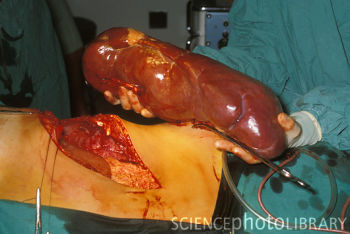
The spleen, ladies and gentlemen. Gratuitous bloody surgical image below Look away now if you're feeling squeamish. (This one's from human medicine)
Subscribe to:
Posts (Atom)